How to Calculate Subnetting Simply with Questions and Answers

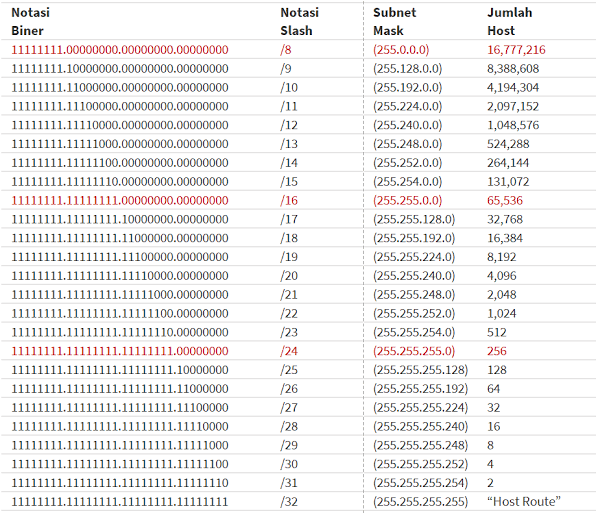
One octet consists of 8 bits (11111111), 1 bit consists of different values, ordered from left to right.
Here we go : 128, 64, 32, 16, 8, 4, 2, 0.
I will not explain the fundamentals of subnetting here, because it is too long, and hopefully those who read this already understand the basics of subnetting, but still often forget 🗿.
OK, here are examples of questions and answers, along with explanations below.
Question
Find the answer below in IP 192.168.10.20/28 (Class C)
Total IP
Specify the Network IP
Specify the Broadcast IP
Range of hosts that can be used
Subnet Mask
Since he is at prefix 192.168.10.20/28, what is the total number of subnets to reach host 20?
Answer
16
192.168.10.16
192.168.10.31
192.168.10.17 - 192.168.10.30
255.255.255.240
There are 2 = (192.168.10.0 - 192.168.10.15) and (192.168.10.16 - 192.168.10.31)
Explanation
Total IP, the formula for calculating the total IP is 2 ^ 4, why 2? because it is grouped between network and broadcast, and so it is 2, and why 4? we count the number of bits 0 in the host segment (4th octet). /28 if converted to binary is 11111111.11111111.11111111.11110000, okay means the number 0 is 4, then 2 ^ 4 the result is 16.
It is clear that the answer is 192.168.10.16, because if calculated from 0 then the range is 192.168.10.0 - 192.168.10.15, so it is fitting that 192.168.10.16 is used as an IP Network.
It is clear that the answer is 192.168.10.31, because the IP range itself is 192.168.10.16 - 192.168.10.31, where .31 is a broadcast.
The host range that can be used, 192.168.10.17 - 192.168.10.30, why is it only up to 30?, because .16 is as a network and .31 as a broadcast, so the host or client cannot use both ip.
Let's convert this /28 to binary numbers and look for the number 1 in the host segment (4th octet), 11111111.11111111.11111111.11110000, which means in arithmetic operations is 128+64+32+16 which results in 240. Then the answer is 255.255.255.240.
Because in this question the IP asked is 192.168.10.20/28, then we are actually in the second subnetting in this /28 prefix. Remember again because the total IP in the /28 prefix itself is 16, now it means that it is clear that we are in the second subnetting. Here's the information: Subnetting 1 = (192.168.10.0 - 192.168.10.15) Subnetting 2 = (192.168.10.16 - 192.168.10.31).
Have a good day mate! ☕.
About the author
Coffee and Computer ☕👨💻
Comments
Join the discussionNo comments yet. Be the first to comment.